
The Master in Modern Times: Confucianism in Present Day China


Because of the atmosphere that often prevails there, I have visited many temples and places of reflection in China and Taiwan over the years. It frequently led me to reflect on the role of religion in East Asia and the differences with the West.
China's greatest philosopher of all time still exerts influence in East Asia and overseas Chinese communities through his aphorisms. In this article, I write about Confucius and the controversial ideas of thinker Jiang Qing.
Text: Alex van Egmond
In April 2011, a bronze sculpture of Confucius was quietly removed from Tiananmen Square in Beijing. The 17-ton monument, which stood in front of the newly renovated National Museum, had been placed there less than four months earlier.
Its installation immediately sparked controversy: devotees saw the statue as the return of the Master and his ideals, after having been condemned during the Cultural Revolution.
Supporters of communist ideals, on the other hand, were deeply offended by the statue's location—so close to Mao Zedong's mausoleum and portrait.
It was deemed inappropriate that such a symbol of feudalism—against which Mao had fought for decades—should stand there on the square.
The statue was moved in the dead of night to an inner courtyard of the museum. This was accompanied by the official statement that its placement on the square had been 'temporary'.
This event illustrates how controversial Confucius still is in contemporary China, but also highlights the dilemma the Communist Party faces—for thirty years after Mao's death, Confucianism is clearly experiencing a revival.
Criticism and Praise
On the one hand, the Communist Party promotes Confucius as a cultural product in its soft power strategy—consider, for example, the naming of the Confucius Institutes that have been established around the world.

Within China itself, Confucian concepts such as obedience to parents and authorities are promoted—especially in the education system. After all, Confucianism and its emphasis on a natural hierarchy align with the paternalistic model of the Chinese Communist Party, which emphasizes loyalty to the Party and social harmony.
On the other hand, Confucianism stands in direct opposition to Marxist-Leninist doctrine, which is based on materialism as the foundation for economic development and on seeking truth through scientific methods—or, as Deng Xiaoping put it: 'Seek truth from facts'.
By contrast, Confucianism is not grounded in materialism or science, but rather stems from idealism and humanistic development, with a focus on cultivating morality to achieve harmony between people and between humanity and nature.
Above all, it is in the very nature of the Party to control any social movement or ideology that could potentially pose a threat to its existence.
That is why Confucianism, alongside support, also encounters considerable resistance — but this was no different in earlier times.
During the Warring States period (475–221 BCE), fierce debates arose between Legalists, Taoists, and Confucians over the best form of government.
Like the Confucians, the Legalists followed strict principles. However, where the Confucians emphasized personal responsibility, the Legalists enforced compliance with laws through strict enforcement and harsh punishments.
The Taoists, by contrast, rejected governing principles altogether, as their law was the ‘Way’—an undefinable, creative force in the universe. To align with the ‘Way’. followers were expected to lead a simple life and withdraw from worldly affairs.
This debate dragged on for centuries, but by the end of the Han dynasty (202 BCE – 220 CE), Confucianism was elevated to the status of state ideology.
An Imperial Academy was established, and the emperor had the final say in matters of doctrine, though he was bound by a moral obligation to safeguard the well-being of the people. Until the fall of the Qing dynasty in 1912, Confucianism remained the official ideology.
Threat
During the long period in which Confucianism served as the state ideology, its interpretation regularly sparked discussions, and various Chinese thinkers—such as Han Yu (768–824), Zhu Xi (1130–1200), and Wang Yangming (1472–1529)—contributed to the development and expansion of the doctrine.

Their contributions are grouped under the term Neo-Confucianism. I won’t go into further detail here, but it is worth noting that Neo-Confucianism in the eighth century was a response to the overwhelming influence of Buddhism.
Similarly, the rise of Western powers from the sixteenth century onward posed a serious threat to the Confucian tradition.
In the late Qing dynasty and the early years of the Republic of China, the political thinker Kang Youwei (1858–1927) advocated for a constitutional monarchy based on the ideals of Confucius.
Twice Kang Youwei presented this proposal to the National Assembly of the fledgling Republic of China, but he never secured the necessary majority.
The Chinese people were fed up with autocrats, and not long after, during the May Fourth Movement, the tide turned completely against Confucius. Supporters of the movement doubted whether the Confucian tradition could still be sustained in modern times.
This was the prelude to the large anti-Confucius campaigns later in the twentieth century, such as 'Criticize Confucius' (1973–1976), launched during the Cultural Revolution by Mao Zedong and his followers.
For Mao, Confucius embodied feudal thinking, and he saw Confucian values as a direct threat to Marxist-Leninist doctrine. His attempts to completely dismantle the traditional system through intense class struggle ultimately failed.
In recent decades, Confucianism has returned in full strength and resonates not only in academic circles but also among broad layers of the population.
Especially the urban middle class seeks solace in Confucius. Rapid economic growth and the accompanying massive urbanization have led many to moral emptiness and alienation.
The downside of materialism, along with widespread corruption and vast disparities in wealth, has deepened doubts about Chinese identity, prompting many Chinese to seek spiritual fulfillment.
The CCP, with its hollow rhetoric and atheistic stance, does not fill this spiritual void — but Confucianism can.
Alternatives
In academic circles, there is also interest in so-called ‘political Confucianism'. While debates in the 1980s and 1990s mainly focused on the cultural aspects of Confucianism, the current emphasis is primarily on its political application.
The most radical group of intellectuals are the ‘New Confucians’, of whom Jiang Qing is the most prominent advocate.
Jiang explains his ideas most thoroughly in A Confucian Constitutional Order. He argues that the Chinese state has been in a crisis for a hundred years due to a lack of legitimacy.

By legitimacy, he means that a ruler must have a foundation upon which to base the right to govern. He rejects both Marxist-Leninist and Western liberal values as solutions to this dilemma, because neither has a cultural or historical place in Chinese history.
Instead, Jiang offers the theoretical model of The Way of Humanistic Authority (Wangdao) and bases it on the kings of the Xia, Shang, and Zhou dynasties.
The choice of these historical figures is remarkable because they are surrounded by a mythical aura, but according to Jiang, that is precisely their appeal: they are idealized yet still have a historical foundation.
In a democracy, on the other hand, legitimacy is based on reason and therefore has no historical background, he argues.
In my opinion, Jiang misses the mark here, because reason in the West certainly has a historical development. Be that as it may, like Kang Youwei, Jiang sees Confucianism as the only remedy for China.
Unlike Western democracies, where legitimacy is determined by popular vote, Jiang bases legitimacy on three sources of humanistic authority: an upper house for the people, an upper house for the sacred (Ru), and an upper house for the nation.
It is important that all upper houses must agree to pass a bill. The upper house for the sacred holds veto power.
Members of the first upper house are elected by popular vote, similar to a democracy. The representative of the upper house for the sacred is chosen by Confucian scholars, who, as in the past, are tested on their knowledge of the doctrine.
The third house is represented by a symbolic monarch, who according to Jiang must be a direct descendant of Confucius. This last element seems like a return to the imperial system, but Jiang draws a separation between the state and the parliament.
Instead of the monarch ruling, the three upper houses govern. The symbolic monarch mediates conflicts, signs bills, international treaties, and so forth. He can also speak out on moral issues, such as environmental degradation, but has no political power beyond that.
Within academic circles, Jiang’s Confucian state model receives both support and much criticism. So far, there is no room for open debate under the current CCP regime led by Xi Jinping.
It rather appears that the Communist Party is inspired by historical legalism and the theories of German political philosopher Carl Schmitt. In the early twentieth century, Schmitt criticized trust in law and liberalism.
Schmitt emphasized the human element in law and believed that a sovereign would be better able to make decisions independent of the law. This amounts to authoritarian authority and rule by law.

It thus takes courage that Jiang continues to advocate for alternative political theorizing, even though he does so (out of necessity) somewhat isolated from his Yangming Academy in Guiyang.
But as the Master said:
'Do not worry that you have no position. Rather, worry whether you deserve one. Do not be saddened that others do not recognize you. Instead, seek what you can do to earn their recognition'.
※※※
The Master
Confucius (or in Chinese 孔子, Kongzi) lived from 551 to 479 BCE and reached the respectable age of seventy-two. He was born in what is now Qufu, in Shandong Province, around the tumultuous Spring and Autumn period of China’s history.
The authority of the Zhou king had been severely weakened, allowing his vassals to go their own way, which led to ongoing rivalries between the various states and noble families.
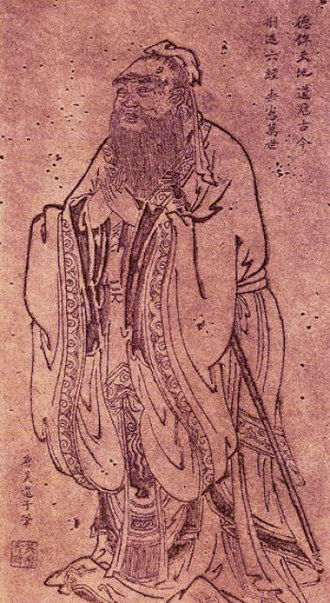
Confucius grew up in the smaller state of Lu and witnessed firsthand how the local nobility was entangled in a power struggle. These aristocratic families were able to seize political power because the duke was more concerned with amassing wealth than with governing the state.
This background shaped Confucius’ thinking on human responsibility in society and the importance of good governance. After failing to restore the duke’s power in the state of Lu, Confucius fled his homeland in 497 BCE.
He then traveled from state to state, passing on his ideas as a private teacher, but was never able to put them into practice. After his death, his sayings were collected by followers in the Analects (Lunyu), a book that can be considered the core of Confucianism.
At its heart lies the challenge for every person to perfect themselves. The Analects contains a collection of aphorisms, but also many dialogues between Confucius and his students, which sometimes offer a glimpse into his daily life.
In chapter ten we read:
'The stable was on fire. When the Master returned from court, he asked: ‘Has anyone been hurt?’ He did not ask about the horses'. (Horses were worth more than a human life at the time.)
The sayings Confucius left behind are often open to multiple interpretations and do not present a general theory of correct conduct.
Jiang Qing's background
Jiang Qing (1953) began his intellectual career as a fervent Marxist but became disillusioned with the way Marxist ideology was propagated by the Party.
When the political climate shifted in 1978, he began studying Politics and Law in Chongqing. During his studies, he read many of Karl Marx’s early works. He concluded that it was not class struggle but rather humanism that underpinned the German’s theories—and that these were aligned with individual freedom, equality, and democracy.

Jiang expressed his criticism in the essay Return to Marxism, but the authorities did not take kindly to it. After graduation, he was assigned a marginal position in the remote province of Guizhou, while his classmates were given prominent posts in Beijing and Shanghai.
After a brief flirtation with Buddhism, Jiang turned to Confucianism, having become familiar with the work of prominent neo-Confucians from Hong Kong and Taiwan.
Until then, he had not even been aware that the Confucian tradition had continued unimpeded outside of China. These twentieth-century Confucians incorporated Western philosophy into their arguments and believed that a synthesis between Confucian and liberal-democratic values was possible.
Jiang found inspiration in their mission, but remained skeptical of liberal democracy as a guiding ideology, believing it neglected China’s cultural, social, and historical realities.
Jiang also proposed abandoning Marxist-Leninist ideology altogether. As a result, his ideas are highly controversial in China and may not be published. Nevertheless, his work is circulated clandestinely and is gaining traction among the Chinese intelligentsia.
Since 2001, Jiang has lived and worked in seclusion at the Yangming Academy he founded in Guiyang (Guizhou), where, like his great role model, he teaches students in the Confucian tradition.
※※※


Comments