
Daoism Alive and Well: The Way in China and Taiwan


In modern times, Daoism has by no means lost its vitality in China and Taiwan.
It can rightfully be called the popular religion of these countries, as it has been passed down for centuries among the people through rituals, customs, and festivals.
All of this has endured without dogmas, schisms, or any significant organizational structure — an achievement in its own right.
How Daoism has managed to manifest itself in this way, and even remains dominant in our time, is the subject of this article.
Text: Alex van Egmond
Prelude
It was in Taiwan, a few years ago now, that I witnessed a sacrificial ritual. A middle-aged woman set up a small table in front of her shop entrance, laid out a cloth, and arranged food offerings next to an incense burner.
She then burned incense as an offering. I assumed she was the owner of the shop. It was September 15th in the Year of the Horse, and the woman had specifically chosen this date because the position of the stars and the moon promised prosperity.
Anyone who signed a contract, moved house, or made an offering on this day could expect good fortune. It was also considered the best day for a cesarean section or adopting a child — but that’s beside the point.
I saw this type of offering in front of shops every week, so it wasn’t anything particularly unusual. What surprised me in this case, however, was that it involved a McDonald’s restaurant. On the table next to the incense burner, Big Macs and McNuggets were neatly laid out.

I look back on this event with great fondness, as it illustrates for me just how alive Daoism is in Taiwan. On the other side of the Strait, in China, Daoism has gone through a difficult period over the past 150 years, and this folk religion nearly collapsed — but it did not disappear.
Essence
In Daoism, there is no almighty god who created the world in six days. The experience is rather this: from primordial chaos, the two forces of yin and yang emerged and merged. They made the appearance of everything in nature possible.
The two forces alternate, complement each other, or stand in contrast, and together they create the Dao — a term often referred to as the Way. Characteristically, the Way defies definition.
It is an all-encompassing principle in the universe, elusive yet creative in nature — but it is not a creator in itself. In the Dao De Jing, the canonical Daoist text attributed to Lao Zi, it says:
‘The Way that can be told of is not an Unvarying Way / The names that can be named are not unvarying names / It was from the Nameless that Heaven and Earth sprang / The named is but the mother that rears the ten thousand creatures, each after its kind’.
(Translation Arthur Waley)
Lao Zi himself, as the supposed founder, is just as elusive, as sinologists have been debating his existence and his role in the creation of the Dao De Jing for decades.
The book was most likely compiled by various Daoist communities and stems from an oral tradition that spans several centuries.
The Dao De Jing, in its current form with 81 rhymed chapters, dates back to the third century BCE.

However it may be, the ideas from the Dao De Jing provided support in times of chaos. Many of the statements in the book are addressed to a ruler and contain advice for good governance.
As a result, the Dao De Jing is often associated with the Warring States period (475–221 BCE), during which the Zhou dynasty increasingly fell into cultural decline, and feudal lords took advantage of the power vacuum.
Confucius lived during the same period, but while the Master emphasized correct etiquette and diligent study to counteract the decline, Lao Zi proposed the opposite — doing nothing.
In chapter 47, Lao Zi says the following:
‘He [= the wise man] knows all the ways of heaven / For the further one travels / The less one knows / Therefore the Sage arrives without going / Sees all without looking / Does nothing, yet achieves everything’.
(Translation Arthur Waley)
Indeed, through non-action, the natural balance is maintained. Lao Zi’s thoughts are based on a universal principle, as he states in chapter 7:
‘Heaven is eternal, the Earth everlasting / How come they to be so? / It is because they do not foster their own lives / That is why they live so long’.
(Translation Arthur Waley)
Daoism appeals to the ideal of freedom and independent thinking. As a result, throughout its long history, it has incorporated various other belief systems, cultural practices, and legends into the Daoist tradition.
For example, the myth surrounding the Eight Immortals, who are always drunkenly wandering and have achieved unity with the Way. Some of them are based on historical figures, including even a member of the imperial family from the Song dynasty.
Furthermore, the common belief is that Confucius was a disciple of Lao Zi and that Buddha was a reincarnation of him. The fixation on eternity and immortality is crucial in Daoist thought.
According to one legend, Lao Zi rides a buffalo into the desert to leave society behind. As he rides toward the boundary between life and death, he writes the Dao De Jing, transcends that boundary, and becomes an immortal.
The Body
A strong drive for survival has saved Daoism from extinction in China. As early as the 19th century, Daoist sanctuaries were destroyed by followers of the Taiping Rebellion, who rallied behind a Christian-inspired leader.

Subsequently, many temples at the beginning of the twentieth century were repurposed as public buildings, as modern China no longer saw value in these religious structures.
The arrival of the communists in 1949 was another blow to the practice of Daoism.
The number of temples in Beijing was drastically reduced, monks and nuns were expelled, and the practice was forbidden. In the end, the Cultural Revolution was almost the final blow, but, a cautious revival has been underway since 1980.
New Daoist associations are joining the official Chinese Daoist Association, and the remaining temples are being reclaimed by Daoist monks and nuns.
However, the folk religion is no longer as visible as it once was, especially not in the large cities. Nevertheless, in Beijing, one can still find the White Cloud Temple (Baiyun Guan). This Daoist sanctuary is located southwest of the Forbidden City and dates back to the eighth century.
At the heart of Daoism’s revival in China, the temple serves as a center for training and a site for major ceremonies. The complex houses monks and novices dedicated to Quanzhen Daoism, one of the most prominent schools in Northern China.

This branch of Daoism emerged in the twelfth century, and its followers placed great importance on extending lifespan and achieving immortality through internal alchemy (neidan shu).
Using meditation and breathing exercises, these Daoists aim to preserve their life energy (jing), with the ultimate goal being the creation of a spiritual body.
Along with the other two components, breath (qi) and mind (shen), jing restores the original unity of the Way and brings the well-known yin and yang into balance. By the way, monks of the Quanzhen order live strictly celibate lives, as they believe ejaculation leads to a loss of life energy.
Daoists' interest in the human body has led to many breakthroughs in medicine over the centuries, with acupuncture being perhaps the most well-known. In essence, acupuncture is a way to restore jing and bring balance to the body.
The White Cloud Temple also houses a clinic, where patients are treated in the traditional manner by Daoist Masters. Daoists view the human body as a microcosm, parallel to the real cosmos.
The five planets — Mercury, Venus, Mars, Jupiter, and Saturn, which are visible to the naked eye — are represented in the five organs.
Daoism specialist, the late Kristofer Schipper, also spoke of ‘the body as the image of a land’, complete with rivers, oceans, mountains, and forests.
The body forms a cycle. In the lower world, the lower abdomen, lies the Great Ocean of the Pneumata or the source of all that lives. The father and mother of the Tao channel the essence of the seed (jing) upward through the spine or the kidneys, for otherwise, it would be lost.
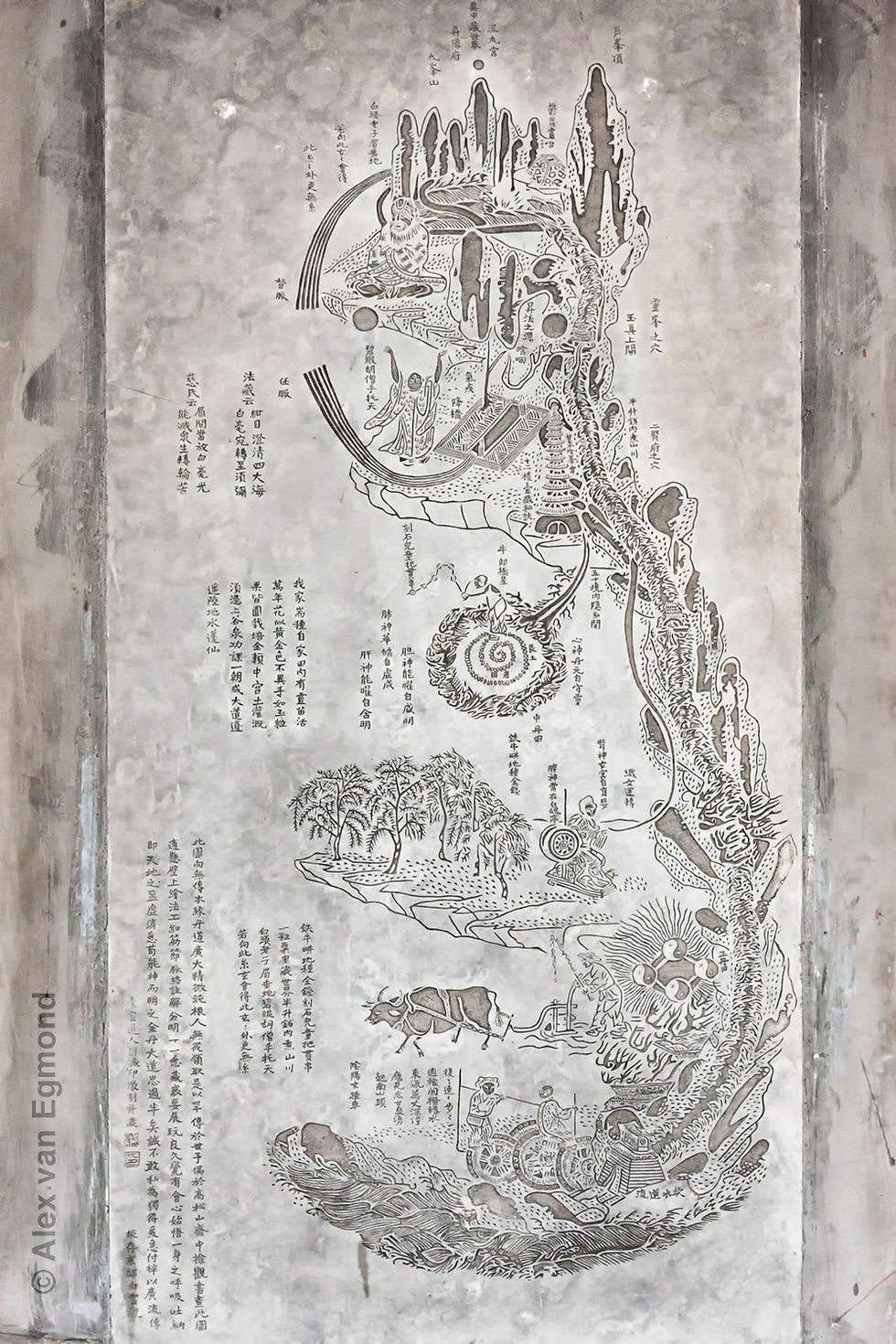
The head represents the mythological Kunlun Mountain, and from there, the energy flows into the mouth and, through saliva, returns to the lungs.
There resides a child, the True Person, the ‘I’ who has detached from social relations and worldly affairs, thus completing the cycle.
Lao Zi himself becomes part of the body of the Way and the eternal cycle when he rides his buffalo toward the boundary between life and death.
According to ancient legends, his body continuously transforms to be reborn into a new one.
It is a strange representation, as complex as Daoism itself, with its many branches and long history.
The Cycle
In contrast to the monastic orders of Quanzhen, Daoist Masters of Zhengyi Daoism live among the people and do not lead a celibate life. However, in essence, they pursue the same ideal of immortality.
In Taiwan, Zhengyi Daoism is the dominant school. Its origins trace back to the second century CE, when in a vision, Lao Zi bestowed the title of Heavenly Master upon Zhang Daoling.
Zhang then founded a sect with the grand name The Way of the Five Bales of Rice (Wudoumidao), named after the contribution new members had to pay upon joining.
Since Zhang’s founding, the line of Heavenly Masters has been continuously maintained, so we are now at the 65th Heavenly Master. Who that is remains a subject of debate, as since the death of the last Heavenly Master, Zhang Yuanxian, in 2008, several Zhangs have been vying for the title.
Ironically, this is quite contradictory to what Daoism advocates, as Lao Zi says in Chapter 30:
‘For what has a time of vigour also has a time of decay / This is against Tao / And what is against Tao will soon perish'.
(Translation Arthur Waley)
However it may be, what is remarkable is that the Heavenly Master is the guardian of the liturgical tradition, the thousands of texts that belong to the Daoist canon. This means that the Heavenly Master has absolutely no authority over temples or other properties. These belong to the people.
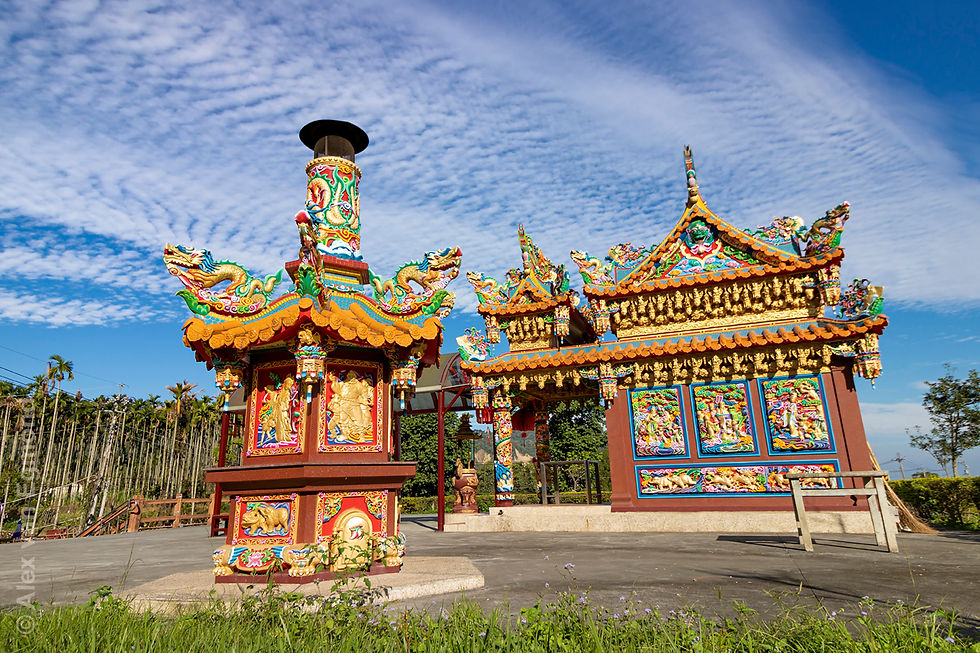
A Daoist sanctuary can be founded and maintained by a community, association, or any group of people. Initially, there is often no building; instead, an incense burner serves as a symbol of unity within the community.
The incense burner holds an important place as an instrument of purification and communication with Heaven within the congregation of worshippers, and it can be passed down each year from one family to another.
The family that holds the incense burner organizes the celebrations that the calendar brings for that year. By the way, the calendar itself has a sacred character, as the cycle of days, months, years, and seasons is also the work of the Way.
Recurring celebrations, in turn, reinforce the cosmic rhythm of the calendar.
Daoist Masters are completely absent from this story, as even without their presence, the community can make offerings and organize celebrations.
But at major events in the cycle, such as birth, marriage, and death, the Master — by invitation — stops by with his altar to lead the rituals.
According to Schipper, the Master is the one who can bind, divide, and unite all beings in the ritual space. It should be noted that one should not attach religious meaning to the ritual, as it is a self-contained action.
Schipper emphasizes this in a 1970 interview:
“There is no human society without ritual, but rituals largely stand on their own. Just like Sinterklaas (Dutch traditional feast) and Christmas, which also largely exist as standalone rituals”.

The Master who performs the ritual has undergone thorough training, which sometimes begins as early as the age of six.
An aspiring Master receives instruction in the correct recitation of sacred texts and the proper choreography, meaning standing as straight as possible.
The highest attainable rank is that of Grand Master. This person is fully initiated after at least twenty years of apprenticeship and is then able to lead the major rituals in the cycle of life. He thereby becomes the heir to the ritual.
Succession is therefore hereditary, but not necessarily so. There are also Daoists with a gift and a calling who embrace the cult of the Way and aspire to become Masters.
They serve as a medium between the everyday and Heaven, a complex phenomenon that can be classified as shamanism. A man — and sometimes a woman — who feels called will go live in the temple and then seek out a Master to impart ritual knowledge.
Entirely in line with Lao Zi and the Way, this calling is a free choice, just as every person is free to follow the natural path in the cycle of birth and death.
A beautiful thought, but with this article I have in fact squandered my qi in an attempt to grasp the ungraspable. If only I had listened more closely to Lao Zi, who says:
‘Do nothing, yet achieve everything'.
※※※
Kristofer Schipper, Daoist Master
Anyone who delves into Daoism can hardly avoid the sinologist Kristofer Schipper (1934–2021). Born in Sweden but raised in the Netherlands, Schipper conducted groundbreaking research on Daoism in Taiwan in the early 1960s.
He studied Chinese, Japanese, and anthropology at the École nationale des langues orientales vivantes in Paris and carried out fieldwork on Daoism in southern Taiwan.
According to an anecdote Schipper himself recounted in an interview on Martin Tse’s YouTube channel, he sought contact with a Daoist Master in Taiwan, but upon arrival was told the Master had just passed away.
Fortunately, there was another Master who was willing to speak with him. He discovered that Daoist rituals were passed down from generation to generation within master-families and was even the first outsider ever to witness a major Daoist ceremony, which took place once every three years and lasted five days.
To get even closer to his subject of study, Schipper had himself initiated as a Daoist Master in 1968, allowing him to gain insight into the organization — or rather the lack of organization — within Daoism.
In a 1970 interview, he said:
“One cannot really speak of a Daoist ‘church’. There is no organization that encompasses both the Masters and the faithful. One could rather say that the Masters form a kind of national corporation among themselves. At the head is the Celestial Master. This exceptional position is passed down from father to son or through adoption”.
His scholarly efforts led to various research projects, including the cataloging and annotation of over 1,500 texts from the Daoist canon, a project completed in 2004.
He gained international recognition as a Daoism specialist with the book The Taoist Body, originally published in French, later translated into Dutch and English.
Schipper also devoted himself to translating Chinese classics into Dutch, including the works of Zhuang Zi, Lao Zi and the Analects of Confucius.
※※※


Comments