
Ferdinand Verbiest: Building bridges and adapting like a chameleon in China


I have previously written about the Nestorians, who settled along the Silk Road in the fifth century AD. Despite the support of Tang Emperor Taizong and the Mongol ruler Kublai Khan, their influence remained limited.
After the fall of the Yuan dynasty in the 14th century, they disappeared from China. Christianity, however, made a return in the late 16th century, when a group of Jesuits arrived at the imperial court in 1582.
Led by the renowned Italian missionary Matteo Ricci, their mission marked the beginning of a close and high-level exchange, with Ricci laying the groundwork for subsequent missions, including that of Ferdinand Verbiest.
In 1659, this Flemish priest came to China and spent the next thirty years impressing the court with his expertise in astronomy and mathematics. This article offers an introduction to the Jesuit mission in China and the life of Verbiest.
Text: Alex van Egmond
Ferdinand Verbiest was born on October 9, 1623, in Pittem, Belgium, near Kortrijk, into an intellectually inclined family. His father began his career as a teacher at the Latin school in Tielt and was later appointed in 1622 as a debt mediator in Pittem.

His mother maintained close ties with prominent families in Bruges. In 1641, at the young age of eighteen, Verbiest joined the Jesuit order, after completing his studies in Leuven and Mechelen.
There, he was educated in theology, philosophy, and mathematics. A paternal uncle, John, was a Franciscan monk who had personally witnessed Jerusalem and Mount Sinai.
The distant travels of Uncle John likely sparked young Verbiest’s own wanderlust. Initially, he hoped to embark on a mission to South America, but the society rejected his request twice.
When the time finally came for deployment, Spanish authorities stood in his way, unwilling to admit a missionary of foreign origin into their conquered territories.
Fifteen years after joining the order, Verbiest agreed to an alternative mission—to China.
The path had already been paved by Matteo Ricci and the German Jesuit Johann Adam Schall von Bell (1582–1666). Schall became a trusted advisor to the young Qing Emperor Shunzhi, which led to his appointment as head of the Imperial Astronomical Bureau in 1645.
Schall introduced a revised version of the Chinese calendar, drawing on the latest developments in Western science. Men with scientific knowledge, especially in astronomy, were in high demand in China, making Verbiest an ideal candidate.
In 1659, after a two-year journey, he arrived in Macau. He was initially sent to Shanxi province, where he learned the language and engaged in missionary work. He adopted the Chinese name Nán Huáirén (南懷仁).
His time in Shanxi, however, was short-lived. After only ten months, he was summoned to Beijing by Schall. Recognizing Verbiest’s mathematical and astronomical expertise, Schall soon made him a valued advisor at the Qing imperial court.
As an astronomer, Verbiest played a crucial role in calibrating and improving the Chinese calendar. Using his knowledge of Western astronomy and mathematics, he was able to make precise predictions of solar and lunar eclipses.
Verbiest also introduced new astronomical instruments and methods, such as the armillary sphere, to assist Chinese astronomers with their observations. Beyond astronomy, he became involved in technological projects, applying his skills to a range of practical challenges.
Verbiest’s achievements contributed to his reputation as a respected scientist and engineer in China.
Ferdinand Verbiest died on January 28, 1688, likely as a result of complications from a fall from his horse the previous year. He was buried with great honor on the Zhalan burial grounds of the Jesuits in Beijing.
An inscription on his stele was written by emperor Kangxi himself and reads:
'You, Nan Huairen, are simple and sincere in heart, broadly learned and thoroughly skilled. You journeyed far across the seas to offer your devotion, and served long in office to exert your abilities [...]. Truly, your work was carried out with precision, and you performed your duties without neglect.'
Chameleon
To achieve success in China, the Jesuits adopted a method of 'adaptation', incorporating elements of Chinese culture and language to spread Christianity and make it understandable to the local population.
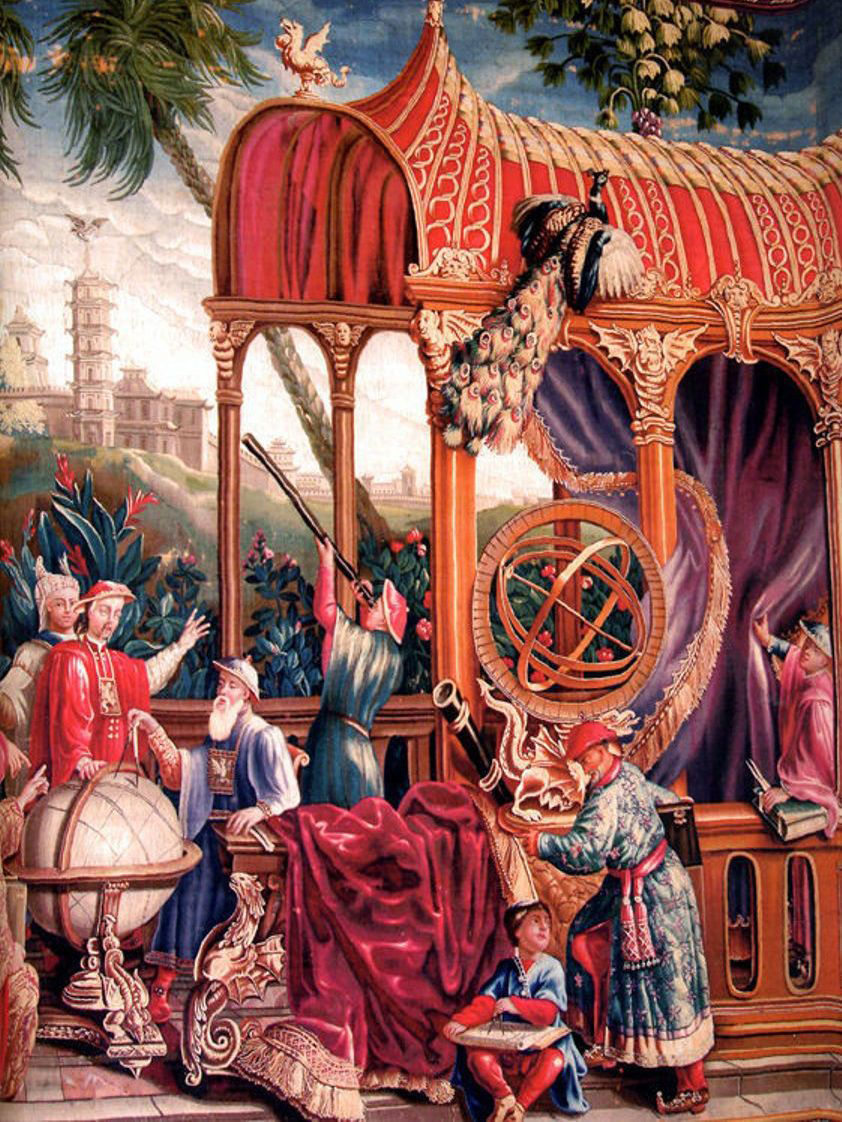
This chameleon-like approach originated with Matteo Ricci, who, unlike earlier missionaries, chose to embrace and understand Chinese culture.
Ricci mastered the Chinese language, studied classical Chinese literature, and adopted the customs and practices of the local population. This approach allowed him to build deeper relationships and gain the trust of the Chinese elite.
Yet, this alone was not enough, as the Chinese sense of cultural superiority meant that foreigners—no matter how intriguing—were often seen as ignorant barbarians.
To overcome this, Ricci had paintings brought to China to visually convey how life was lived in Europe. Western technology was also shipped over, including clocks, sundials, and other instruments.
These objects had the desired effect, gradually allowing Ricci to gain access to Emperor Wanli. Verbiest followed a similar path: he learned Chinese and adopted the robes of a mandarin.
At the beginning of 1660, the year Schall summoned Verbiest to Beijing, prospects looked promising for the mission in China.
Schall’s appointment to the Astronomical Bureau conferred significant status, and around 10,000 converts joined the Church each year. In a letter from 1660, Verbiest wrote optimistically about the honors he had received along the way:
'In the cities I passed through, I was always met at the outermost boundaries of the territory by eight or ten horsemen with banners, trumpets, drums, and cymbals. When my sedan chair came into view, they would leap from their horses, fall to their knees, and bow—together with the banners—bringing their heads to the ground. All the while, they shouted loudly and wished me well on my journey to their city'.
Upon his arrival in Beijing, Verbiest quickly realized that the Chinese were deeply attached to their traditions, and that the success of the mission depended largely on accurate astronomical predictions.

As the emperor was considered to stand between heaven and earth, with the mandate to rule, he was expected to have control over the days and months. Accurate calendar calculations were therefore of crucial importance.
Despite the groundwork laid by predecessors like Ricci and Schall’s close relationship with Emperor Shunzhi, suspicion and mistrust continued to plague the Jesuit mission.
When the emperor died of smallpox on February 5, 1661, difficult times began for the missionaries. Shunzhi’s seven-year-old son became the new emperor.
He took the name Kangxi, but was still too young to rule, so power fell into the hands of a group of four regents.
Difficulties
A group of traditionalists at the court remained suspicious of the Westerners and the science they brought with them. Many of them believed that the Jesuits’ scientific ideas had originated in China—a notion that had some merit.
The Chinese already had a long-standing tradition in astronomy and calendar-making.
Apart from adopting a few improvements, the traditionalists pushed for the removal of Western technology from Chinese society.
The Jesuits’ missionary activities were also met with suspicion. Between 1659 and 1669, an anti-Western, xenophobic movement was led by Yang Guangxian, an irritable nationalist who, in truth, had little knowledge of astronomy.
Attacks on the calendar introduced by Schall proved largely ineffective, so Yang directed his criticism toward what he saw as the barbaric and immoral practices of the Christians. In pamphlets, he appealed to the patriotic feelings of the Chinese people and sought to discredit the true faith.

The Jesuits, for their part, refuted the accusations, but this only fueled patriotic sentiment. In 1664, Yang brought a severe charge: conspiracy against the empire and the dissemination of a corrupting doctrine.
After weeks of interrogation, Schall, Verbiest, and seven other defendants were transferred to prison, where they were chained to heavy wooden blocks, unable to stand or sit.
Months later, in March 1665, Schall and seven others were sentenced to death. Verbiest’s sentence was more lenient: exile and one hundred lashes.
However, the course of events changed. Before the execution could take place, a comet was observed in the sky, followed by three strong earthquakes that caused buildings to collapse and damaged the city wall of Beijing.
Also, in one of the walls surrounding the Forbidden City, a large crack appeared, and because of the aftershocks, the young emperor was forced to sleep outside.
The emperor and his regents could not ignore so many warnings, and the prisoners were released from confinement.
They were not yet fully free, however, and remained under house arrest for several years in their residence southwest of the Forbidden City. For the 74-year-old Schall, the months of imprisonment took a heavy toll on his health, and he died in 1666.

Verbiest remained behind with three other priests, trying their best to defend themselves against the ongoing accusations. It must be said that the Jesuits slinged mud just as skillfully as Yang Guangxian.
Meanwhile, Yang, newly appointed head of the Astronomical Bureau, implemented a calendar based on the old methods, but his predictions proved inaccurate.
Eventually, in 1668, Emperor Kangxi gave Verbiest a series of astronomical tests to determine which method was superior. In the final trial, the emperor set Verbiest against Yang in a kind of duel. Both men made observations from the observatory in Beijing and then began their calculations.
Verbiest passed the trials with flying colors, thereby restoring the Jesuits’ honor. Yang was dismissed from his position, and henceforth the Jesuits’ insights were used in calendar calculations.
Verbiest remained closely involved in calendar reforms and, in 1672, was appointed head of the Astronomical Bureau by Kangxi. This marked the beginning of a remarkable relationship between the priest and the emperor.
Legacy
In the years following the incident with Yang Guangxian, Verbiest was regularly summoned by the emperor to teach him subjects such as astronomy, mathematics, and geography.
Kangxi clearly had a keen interest in the world beyond his empire, and Verbiest was only too happy to oblige. Secretly, Verbiest hoped the emperor might convert to Christianity, but that would never happen.
The Son of Heaven stood above God, and his subjects were expected to obey. Thus, the Jesuits’ primary goal—converting the Chinese—remained unattained.
It mattered little anyway, as between 1661 and 1692, gaining followers and building new churches was prohibited by the emperor. Only Westerners were allowed to practice their faith within the empire’s borders.
In addition, the duties Verbiest had at the Astronomical Bureau, along with all the accompanying formal obligations, weighed heavily on him.
In a letter to another priest, he wrote candidly:
'How much rather would I, if I could choose for myself, live the life of our blessed Francis Xavier — travelling the missions on foot and living among the poor Christians — instead of having to win the favor of the mandarins here'.
Yet, in his own way, Verbiest paved the way for a successful mission, even if its fruits would only be realized after his death.
For the emperor, Verbiest served also frequently as an advisor on engineering and construction projects, such as the creation of six astronomical instruments for the observatory, hydraulic works, and the manufacturing of cannons.

The Wusangui Rebellion (1673–1681) in the southern provinces compelled the emperor to produce war matériel. Remarkably, during Kangxi’s fifty-year reign, 905 cannons were manufactured, and Verbiest oversaw half of them.
He conducted systematic research on the subject and wrote treatises on cannon production, significantly improving their quality. Initially, Verbiest tried to avoid this assignment, as warfare was not the reason he had come to China.
The emperor tactfully pointed out that a defeat might bring new rulers who would be far less favorable toward the missionaries.
Verbiest therefore accepted the task and carried it out with great diligence and dedication, despite his moral reservations. However, purely scientific inventions cannot be attributed to Verbiest, as he lacked the time to pursue them amid the numerous responsibilities assigned to him at court.
Science was never Verbiest’s ultimate goal; rather, it served as a means to gain favor with the elite.
On the other hand, he was highly creative and successful in transmitting scientific knowledge, contributing to improvements in astronomical observations, cannon design, and cartography in China.
Four years after Verbiest's death, Kangxi permitted the Roman Catholic Church to win converts among the Chinese population and allowed the construction of new churches.
Verbiest is still remembered today as a remarkable Belgian Jesuit missionary who left a lasting impact on science, technology, and Christianity in China.
※※※
Matteo Ricci
Ricci was born in Macerata, Italy, in 1552. He joined the Society of Jesus and, in 1577, set out as a missionary to Asia. His first destination was Goa, India, where he learned Portuguese and became acquainted with the cultures and religions of the East.
After several years in India, Ricci moved to China, where he would carry out his most remarkable missionary work. Ricci introduced Christianity to China and began translating Christian texts into Chinese.

His most remarkable work was the translation of several important Christian texts, including The Treatise on the Friend of God by John of the Cross.
These translations were crucial in making Christianity accessible to the Chinese intellectual elite.
Another significant aspect of Ricci’s missionary work was his scientific contributions. He was the first to introduce European astronomical instruments to China and shared knowledge of Western science and mathematics with Chinese scholars.
In doing so, he fostered mutual appreciation and understanding. For example, Ricci introduced the Chinese community to the world of Western cartography and produced the famous Map of China in 1602, which was highly detailed and accurate for its time.
This map combined Chinese and Western knowledge of the world and demonstrated that the Earth was round—a revolutionary idea for many Chinese at the time. Ricci’s mission also addressed ethical and moral questions.
He sought to integrate Christianity with the existing ethical and moral values of Chinese society, further strengthening the relationship between the two cultures. Ricci emphasized virtue and moral principles in his work, showing how they aligned with Confucian ethics, which resonated with many Chinese.
At the time of his death in 1610, the number of converts was modest—around two thousand Chinese—but his missionary work left a lasting impact on the history and culture of both China and the Western world.
Matteo Ricci was not only a missionary but also a bridge-builder between two worlds.
Concept for a steam vehicle
In 1672, Verbiest designed a concept for a steam-powered vehicle. The design was remarkable for its time, given that steam propulsion was still in its infancy.
Verbiest did not have access to the advanced technology and materials that would be available a century later to actually build a sizeable steam engine.

The basic concept of Verbiest’s steam vehicle involved a boiler that heated water to produce steam. The steam was then directed through pipes to a cylinder, where it moved a piston.
This motion would be transferred to the wheels to propel the vehicle forward. The design was simple and rudimentary compared to modern steam engines, but it represented an important first step in the development of steam-powered vehicles.
It is important to note that Verbiest’s design was never meant as a functional steam vehicle. For Verbiest, the installation was merely one of the many playthings with which he entertained the children at the court.
It would take several more decades before the first working steam vehicles were constructed, such as Nicolas-Joseph Cugnot’s in the eighteenth century. Many regard Verbiest’s design as the first 'steam car', but this is misleading, as the vehicle was not intended for actual use.
For example, it had no seats or steering mechanism. While Verbiest’s design never resulted in a practical vehicle, it demonstrates the foresight of this remarkable scientist and missionary.
※※※



Comments