
Confucianism Across the Strait: The Master in Contemporary Taiwan


In the first part of this two-part series, I wrote about Confucianism in China and the difficult, often contradictory way in which the Communist Party deals with the ideals of its greatest philosopher, as well as how intellectuals like Jiang Qing engage with political Confucianism.
For this article, I look at the role the philosopher plays in Taiwan’s current cultural and political life. As it turns out, there are similarities with the debate in China, but the outcome for Taiwan differs.
Text: Alex van Egmond
As in the rest of the world, World War II marked a major turning point for Taiwan, as it signaled the transition from Japanese colonial rule to the Kuomintang (KMT) regime under Chiang Kai-shek.
The Japanese colonizers promoted only Buddhism on the island, as it aligned better with Japanese culture. The idea was that this would help the local population adapt more easily to the planned transition to Shinto, Japan’s native religion.
This does not mean that other belief systems disappeared, as Confucianism and Taoism continued to accompany Buddhism. This is why temples in Taiwan even today often appear as a mixture of various traditions.
The arrival of the KMT brought a drastic change to religious life on the island, as the new regime eagerly promoted Confucianism.
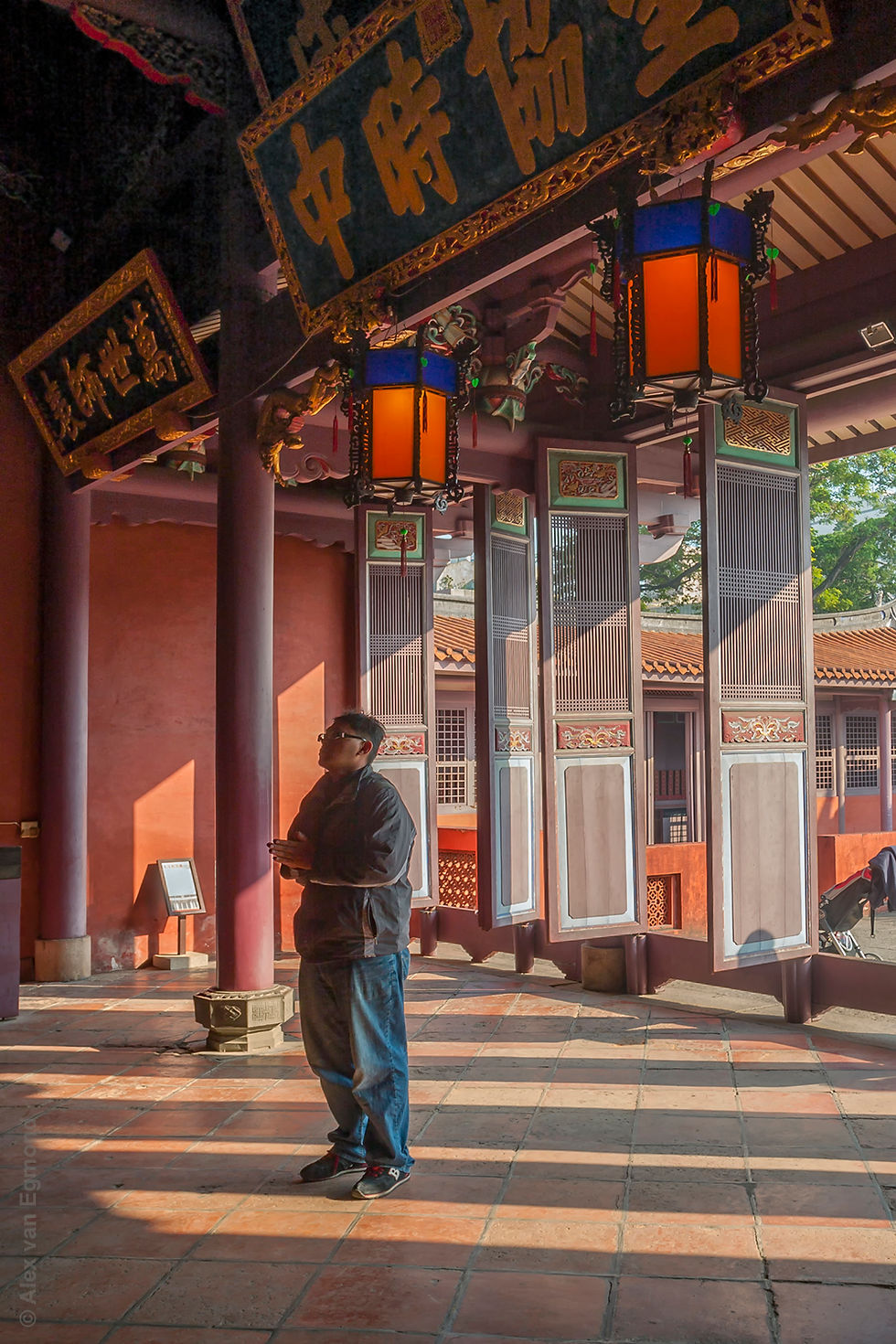
Chiang Kai-shek himself created a calligraphic plaque inscribed with a Confucian text for the temple in Tainan, and in 1952 he declared September 28th the birthday of the Master.
In addition, two new Confucius temples were built in Kaohsiung and Taichung. However, state support for Confucianism truly gained momentum in 1967, with the founding of the Council for the Promotion of Chinese Cultural Renaissance, chaired by Chiang Kai-shek himself.
The first official veneration of Confucius in Taiwan began in 1665 with the founding of the Confucius Temple in Tainan.
After Zheng Chenggong—better known in the West as Koxinga—defeated the Dutch in 1662, he launched a campaign to erase all traces of the Dutch East India Company (VOC) regime.
Ruling Taiwan under the name of the Kingdom of Tungning, Koxinga dismantled VOC forts, renamed locations, and introduced a classical Chinese bureaucracy.
A few months after the Dutch capitulation, Koxinga died, and his son Zheng Jing took over the kingdom. On the island, he continued his father’s mission, establishing a stronghold for Ming culture.
This attracted intellectuals from the mainland, who, under the new Qing government, faced suspicion and even persecution.
In Taiwan, these literati lived in exile, longing for the day they could return to the mainland to restore the Ming dynasty.
Naturally, a Confucius temple fit well with this culture-loving community. In February 1666, Zheng Jing ceremonially inaugurated the temple.
At the same time, he introduced a Confucian academy, allowing students to participate in the imperial civil service examination. After the Qing government decisively defeated the Zheng clan in 1683, it continued the activities of the Confucius temple and academy.
However, the academy was not particularly successful. It is estimated that throughout the entire Qing period, only 251 candidates from Taiwan sat for the imperial examination, with just one achieving a passing result.
When the imperial examination system was abolished in 1905, the academy lost its purpose, but the Confucius Temple in Tainan remained active. More than 350 years later, it still is: ceremonies and festivals are regularly held there.
Doctrine
The establishment of the Council for the Promotion of Chinese Cultural Renaissance was a response to the Cultural Revolution taking place in China. The council’s main goal was to revitalize Chinese culture by analyzing and commenting on Confucian texts, but this aim extended beyond mere cultural influence.
The council’s activities were also aimed at improving morality among the population.
Education underwent a reform of its teaching materials, emphasizing not only hard work and cooperation but also obedience to parents and the state as the foremost virtues.

Cultivating obedience to the government fit well with the paternalistic nature of the KMT and shows similarities to the model of the Communist Party in China today. Confucianism as a state ideology thus emerged as a tool to generate goodwill for the KMT regime.
On the officially designated birthday of Confucius, September 28, Chiang Kai-shek emphasized the greatness and timeless value of the philosopher in a 1968 speech. In his view, Confucius was neither feudal nor anti-revolutionary.
For teachers, he delivered the following message:
'The purpose of education is to produce a person who conducts himself correctly, with dignity and propriety [...]. The result of proper etiquette is that every individual in the family or society values his appropriate role and follows strict discipline'.
Promoting Confucian values through education was part of a doctrine aimed at fostering unity, a doctrine rooted in Sun Yat-sen’s Three Principles of the People: nationalism, democracy, and welfare.
Under the principle of nationalism, the KMT pursued a policy of Sinicization, which included promoting Mandarin Chinese as the official language while discouraging local languages, customs, and traditions.
According to Sun Yat-sen’s vision, democracy had to be preceded by a transitional period of one-party rule, as the proper economic, social, and political conditions needed to be established before democracy could flourish.
Although the KMT postponed democratic reforms until well into the 1980s, the regime was highly successful in creating prosperity.
Between 1950 and 1980, Taiwan’s GDP grew by an average of 8% per year, and the island transitioned from an agrarian to an industrial economy, dramatically transforming the standard of living for the Taiwanese population.
The other Asian Tigers—South Korea, Singapore, and Hong Kong—experienced comparable economic growth.
Among academics, there is consensus that Confucian values—such as frugality, diligence, and the government’s responsibility to provide for the people’s basic needs—played an essential role in these economic miracles.
Democratic
It can be concluded that Confucius’s ideals had a positive impact on the rise of the Four Asian Tigers, but how the philosopher’s thought relates to democratic values remains a topic of heated debate.
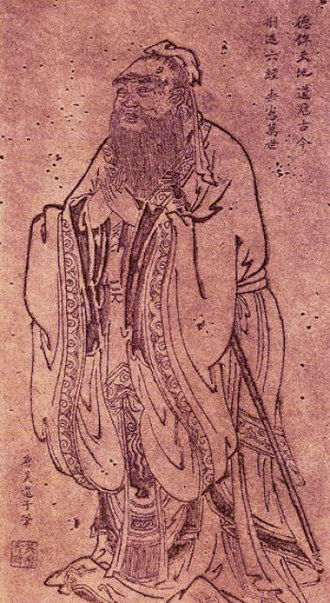
On the one hand, Confucius places strong emphasis on hierarchy and order, which makes his philosophy appear highly authoritarian. For example, he describes the relationship between ruler and people as follows:
'When the wind passes over the grass, the grass must bend'.
Moreover, Confucius asserts that the individual is subordinate to the collective, which is difficult to reconcile with the notion of individual rights in a liberal democracy.
He also stresses that each person should act according to their role and status in society:
'There is government when the prince is a prince, the minister a minister, the father a father, and the son a son'.
On the other hand, scholars emphasize that Confucian thought is open to multiple interpretations and indeed shares some overlap with democratic values.
In The Analects, Confucius emphasizes the importance of good governance that rules with justice and serves as an example for the people.
When the statesman Ji Kangzi once asked how best to serve the people, the philosopher replied:
'Approach the people with respect, and they will show reverence in return'.
Harmony between ruler and people, then, follows the natural way and cannot be imposed through punishment. Confucius also places great emphasis on education as a means of becoming a virtuous person.
Both rulers and citizens share this lifelong task, and Confucius approaches it from a perspective of equality. Rulers are not a special class nor chosen by some higher order, as Confucius values knowledge more highly than social origin.
In this sense, he upholds the principle of equality. But what if the government is corrupt? For Confucius, the people are not a passive, submissive mass; every person possesses an independent mind and the capacity for reasoning.
An individual, he argues, should speak out critically, for otherwise the state will perish:
“If the ruler is good, and no one is disobedient, is that not excellent? But if he is not good, and no one dares oppose him, would this not be precisely the formula that brings a country to ruin?”
Such statements can be interpreted as support for freedom of expression. Yet, as noted, Confucius’ teachings are open to many interpretations, which is why for centuries he has been invoked in service of a wide variety of political causes.
Introspection
Taiwan democratized after the lifting of martial law in 1987 and transitioned to a multi-party system.
The National Assembly elections of 1991 and the general elections of 1996 were significant milestones, but perhaps even more crucial was the election of Chen Shui-bian in 2000, the first president from the opposition Democratic Progressive Party (DPP).
Since then, the island has been engaged in a process of introspection, with both its past and future taking center stage.

On the one hand, people are looking back at history and re-evaluating the colonial past. For example, there is a renewed appreciation of the Japanese period, with buildings and monuments being restored.
On the other hand, a strong Taiwanese identity is emerging, prompting reflection on what it means to be Taiwanese. In contrast to the KMT era, indigenous peoples are now included in this discussion.
It should be noted that the constitution introduced by the KMT in 1947 completely ignored the existence of indigenous peoples, and this was not revised until the late 1990s.
Confucianism, as one of the pillars underpinning the KMT’s power, consequently hindered the democratic process.
The KMT’s emphasis on paternalistic values such as social harmony and hierarchy tarnished the Confucian tradition, leading activists to distance themselves from Confucius.

Peng Ming-min (1923–2022), a prominent figure in Taiwan’s democratization movement, rejected Confucianism as a basis for a modern rule of law. In a 2007 interview, he stated:
'We in the democratization movement based our ideas on Western thought. Personally, I do not believe there is a connection between Confucian thought and Western democracy'.
Other activists echoed Peng’s view, also seeing Confucianism as an obstacle to democracy. This perspective was partly shaped by the fact that Confucianism had been an integral part of the KMT’s nationalist policies, from which the opposition naturally sought to break.
Nevertheless, Confucianism has not disappeared under the DPP. Firstly, Taiwanese schools continue to teach the Confucian tradition, though now without state promotion as had been the case under the KMT.

The government no longer prescribes ideology and formally distances itself from Confucianism, instead placing greater emphasis on Taiwanese history and culture.
Secondly, Confucian values remain popular among the population, particularly family loyalty, which ranks highest, followed by support for social hierarchy and social harmony.
Over time, the latter two values have become less popular, while loyalty to the family has grown. Support for this value does not hinder democratization, which is both remarkable and encouraging.
In short, Taiwan is by no means done with Confucius.
※※※
Universal Vision
Confucianism is unlike Western monotheistic religions such as Christianity or Catholicism, which are based on revelation and the worship of a supreme being.
It is more a philosophical outlook on how a person should live, grounded in ethical principles, making it appropriate to describe it as a system of virtues. Confucius based his ethics on the histories of the mythical kings of the Xia, Shang, and Zhou dynasties, rather than on the supernatural.
He did not see himself as an innovator but transmitted what previous generations had developed. As he states in The Analects:
'Those who, through their familiarity with the past, are able to develop insights in the present, are worthy to be called Masters'.
In East Asia, Confucius is not worshiped as a deity, and temples dedicated to the Master are notable for their simplicity. Confucius left no formal system or set of rules for his followers.

His teachings were primarily directed at the individuals he advised, always emphasizing self-cultivation and the natural pursuit of harmony. These guidelines are applicable to anyone, and it is precisely this universality that gives his thought its enduring appeal.
Gottfried Wilhelm Leibniz (1646–1716), the first Western thinker to study Confucius in depth, recognized the universal character of Confucian thought and proposed the idea of a universal system of ideas, within which different cultures could coexist in harmony and without conflict.
As with Confucius, the period in which Leibniz lived shaped his thinking; Europe was still recovering from the upheaval of religious wars. A universal ideology was therefore preferable to the notion of a single true god.
※※※


Comments