
An Eye and an Arm as Medicine: Guanyin Worship on the Island of Putuoshan

Updated: Dec 30, 2024

Guanyin, also known as the Goddess of Compassion, is a popular figure in East Asia due to her compassion, mercy, and unconditional love for all living beings.
Her origin lies in ancient Indian Buddhism, where she was known as Avalokiteshvara and appeared in a male form. Over time, her image and teachings were adopted and adapted in China, where she is now depicted as a female deity.
According to legend, she appeared as a bodhisattva on the island of Putuoshan and attained enlightenment there. This is why the small island off the coast of Zhejiang province has a strong appeal for pilgrims, who have been visiting this spiritual site for centuries to worship the goddess. With a bit of luck, they might even experience her presence.
Text: Alex van Egmond
Origin
The story of Guanyin begins with the figure Avalokiteshvara, a male bodhisattva of compassion in Mahayana Buddhism. In the first Chinese translation of the Lotus Sutra (276 AD), this figure is referred to as Guanshiyin (觀世音), which in Chinese means 'she who hears all prayers and looks down upon the world, hearing all cries for help'.
Over time, Avalokiteshvara underwent a transformation, with the figure's image changing from male to female. This change can be explained by various factors, including cultural, religious, and social influences.
Firstly, cultural and religious considerations played a role in Avalokiteshvara's transformation into Guanyin. In some cultures, especially in East Asia, the feminine aspect was associated with compassion, grace, and motherly love.
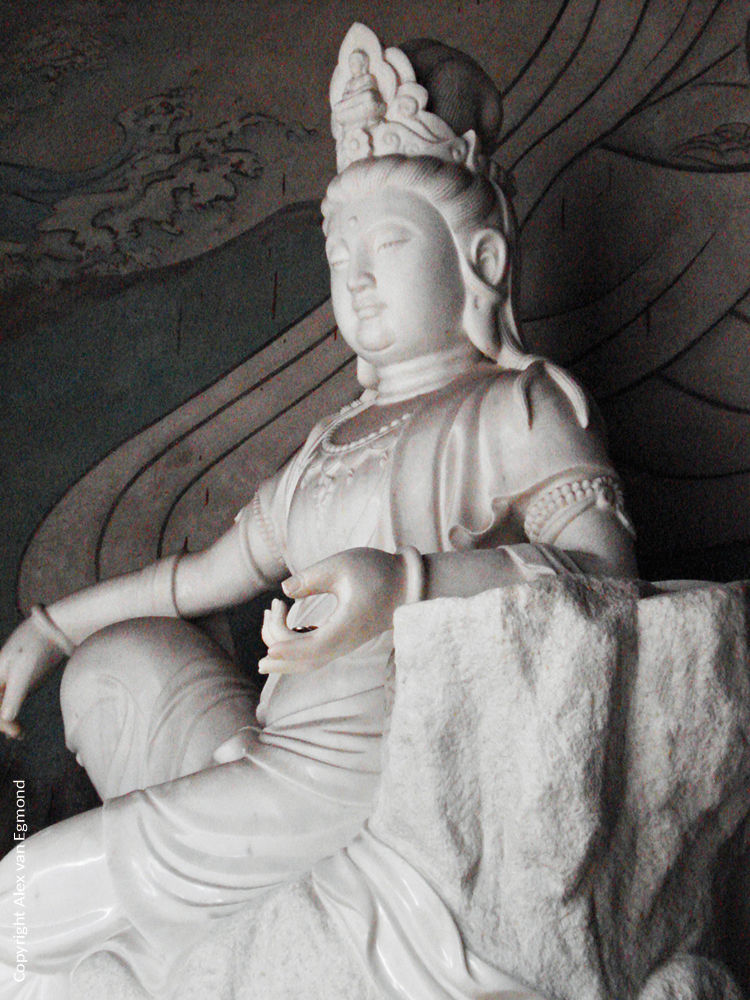
The image of Guanyin as a female deity aligned more closely with the symbolism of compassion and mercy that she represented. This also fit within the broader context of Chinese Taoism, where female deities and the reverence for feminine energy were pervasive.
In addition, social factors contributed to this transformation. A strong devotion In Chinese Buddhism developed for Guanyin, particularly among women.
The image of a female deity like Guanyin provided women with a relatable figure to turn to, someone who showed empathy and understanding for their specific struggles and concerns. This created a strong bond between the worship of Guanyin and women in society.
Secondly, it is important to understand the context of the Tang Dynasty (618-907) and the emperor's attitude toward Buddhism. The Tang Dynasty was an era of political stability, economic prosperity, and cultural flourishing in China.
For most of this period, Buddhism received significant support from the imperial family and the ruling elite. Emperor Taizong (598-649) in particular, was favorably disposed toward Buddhism and saw it as a positive influence on society, supporting its spread.
Emperor Taizong himself practiced Buddhism actively and contributed to the construction of Buddhist temples and the promotion of Buddhist scriptures. The imperial support for Buddhism during the Tang Dynasty created a favorable climate for the spread and development of the faith.
As a result, Buddhism became an integral part of Chinese culture, blending with local traditions and beliefs, such as Taoism and Confucianism.
Around 828, a statue of Guanyin was present in many Buddhist temples. The legend of Miaoshan was likely already circulating around this time.
※※※
Once upon a time, there was a princess born during the Tang Dynasty, named Miaoshan. She was the third daughter of King Miaozhuang and was raised in wealth and luxury.
However, from a young age, Miaoshan showed a strong aversion to worldly possessions and a deep desire to follow the religious path.
Her father, King Miaozhuang, planned to arrange a marriage for her. But Miaoshan repeatedly refused to marry, choosing instead a life of chastity and spiritual devotion. This caused great anger and misunderstanding from her father.
According to legend, Miaoshan underwent severe trials to convince her father of her commitment to the Buddhist path. She endured torture, was sent to a monastery, and faced numerous hardships.
Despite everything, she remained steadfast in her spiritual quest. Her father even went so far as to sentence her to death, but during the execution, the sword shattered on her neck.
At the end of the legend, King Miaozhuang develops a liver disease that can only be cured if a kind and selfless person donates their arm and eye. Unbeknownst to her father, Miaoshan sacrifices her arms and eyes.
The king is healed and goes to the temple to thank the donor. When he discovers that it was his own daughter, he falls to his knees in shame and begs for forgiveness.
Miaoshan then transforms into Guanyin, the thousand-armed bodhisattva of Avalokiteshvara.
This tale, which was engraved in stone in 1100 as The Cult of Miaoshan at the Monastery of the Fragrant Hills, reflects Guanyin's boundless compassion and self-sacrifice.
The story links the ancient legend of Miaoshan, which had previously circulated only in fragments, with that of Guanyin. It emphasizes the importance of helping others, even if it requires personal sacrifice.
But even more, this legend serves as a justification of Buddhism over the then-dominant Confucianism. Many women were trapped in their social roles as future wives and mothers.
The Miaoshan legend offered an alternative: by resisting her father’s wishes, she remains chaste, despite this contradicting the Confucian ideal of filial obedience.
※※※
Putuo Island
Putuo, as a pilgrimage site, is closely tied to the spread and development of Buddhism in China. During the Han Dynasty (206 BCE–220 CE), the first Buddhist monks appeared in China, spreading the faith along the Silk Road.

They brought Indian scriptures, which were translated into Chinese in the following centuries. In the previously mentioned Lotus Sutra, there is a reference to Potekala, the mountain where the bodhisattva Avalokiteshvara appears.
The description of Mount Potekala is quite vague, leading various mountain peaks across Asia to be gradually associated with the mythical Potekala, including Mount Putuo.
Two events established Putuo as a Potekala: in 847, an Indian monk settled on the mountain, claiming he had received direct teachings from the Bodhisattva Avalokiteshvara. Around the same time, the Japanese monk Egaku was stranded on the island after a storm.
According to legend, Egaku was en route to Japan with a statue of Guanyin that he had obtained during a pilgrimage to Mount Wutai. Only by leaving the statue behind was Egaku granted permission from Guanyin to continue his journey to Japan.
Egaku established a temple to house the statue, which has since been known as 'Unwilling-to-leave-Guanyin-Temple'.
The popularity of Putuo Island grew over the centuries as a pilgrimage site for Buddhists. Emperors, scholars, diplomats, and believers visited the island to meditate, pray, and study.
Putuo was advantageously located at the intersection of maritime routes, which explains its connections with Japan, Korea, and India. In subsequent dynasties, Putuoshan experienced both highs and lows in its spiritual and physical development.

The long-standing presence of Buddhism on the island led to numerous renovations, expansions, and changes to its temples and monasteries. Some were destroyed in wars and uprisings, while others were rebuilt and restored.
In 1665, the Dutch looted bronze statues and other items from the temples with an estimated value of 200,000 taels of silver (over €40,000). In 1387, nearly all temples were destroyed when the Ming emperor issued a maritime embargo, halting sea trade.
During the Qing Dynasty (1636–1912), Buddhism reached its peak on the island, with the construction of many new temples and monasteries. Much of the existing architecture found on the island today originated from this period.
For instance, Emperor Kangxi sent funds to the island through his eunuchs to build temples and emphasized the imperial status of the island in an edict. By the late nineteenth century, the island became popular among foreigners for its beautiful beaches.
Once a steamboat service from Ningbo and later from Shanghai was established, Putuo became an enjoyable day trip destination for them. After the founding of the People’s Republic of China in 1949, Buddhism was initially suppressed during the Cultural Revolution (1966–1976).
Temples were closed, and monks were forced to abandon religious life, including those on Putuo. A small number of elderly monks were permitted to remain on the island to live out their final years, but it’s estimated that 17,000 statues and 34,000 books were destroyed by the Red Guards.
However, after this period of suppression, Buddhism experienced a revival. Putuoshan once again became a significant destination for Buddhist pilgrims and tourists, with tourists far outnumbering pilgrims.
The main Buddhist temples, such as the Fayu Temple, Huiji Temple, and Puji Temple, have been restored and serve as important spiritual centers.

Asian Mary
The relationship between Guanyin and Mother Mary is interesting from an interreligious perspective, where similarities and comparisons between different religions and spiritual figures are explored.
Although Guanyin originates from Buddhism and Mother Mary from Christianity, there are some striking similarities between these two figures of compassion and grace.
One of the most significant similarities between Guanyin and Mother Mary is their role as symbols of compassion and mercy. Both are known for their unconditional love for all beings and their willingness to offer help to those who suffer.
Both Guanyin and Mother Mary are seen as comforting figures who listen to the pleas and prayers of people and support them in their difficulties.
Both Guanyin and Mother Mary especially appeal to women who wish for a child or seek protection during childbirth. In the Lotus Sutra, Guanyin listens to women who ask for a healthy son and grants these pleas.
Another notable aspect of their relationship is the iconographic resemblance between the two figures. Both Guanyin and Mother Mary are often depicted with a serene and compassionate expression, accompanied by a child and a flower: Guanyin with a lotus blossom and Mother Mary with a carnation.
Both Mother Mary and Guanyin are also venerated by sailors and fishermen. In France, for instance, a statue of Mother Mary takes part in a water procession on August 15, while in East Asia, Guanyin became associated with the sea’s protectress, Mazu.
The blending and adoption of various elements within the Chinese religious system is, in itself, nothing new. The relationship between Mother Mary and Guanyin is further demonstrated by the discovery of Guanyin figurines in Japan that were secretly worshipped by Christians.
During the Edo period (1603–1868), practicing the 'foreign' religion was forbidden for two centuries, so Japanese Christians posed as Buddhists and clandestinely practiced their faith. Hidden Christian symbols were discreetly embedded within these Guanyin figurines.
While there are indeed similarities between Guanyin and Mother Mary, it’s important to emphasize that each has their own unique context and meaning within their respective religions.

Guanyin is seen as a bodhisattva, a being who strives for enlightenment and chooses to remain in the worldly realm to help others. Mother Mary, on the other hand, is revered as the mother of Jesus Christ, the Son of God.
Despite these differences, people continue to build bridges between the veneration of Guanyin and Mother Mary, highlighting their shared values of compassion, mercy, and unconditional love.
Emphasizing the spiritual wisdom and virtues of both figures aims to foster mutual understanding and respect between Buddhists and Christians.
Appearances
Many sacred places around the world are associated with miracles and other unexplained events. Consider pilgrimage sites like the grotto of Lourdes in France, where, after the Virgin Mary appeared to the young girl Bernadette in 1858, dozens of healings and other miraculous occurrences took place.
The possibility of having an extraordinary experience makes pilgrimages appealing, and Mount Putuo is no exception. The legend of the Japanese monk Egaku has already been mentioned, but there have been other mysterious events reported.
Many appearances of Guanyin have been said to occur near the Cave of Tidal Sounds in the southeastern part of the island, where waves have crashed against the rocks of a peninsula for centuries, near the Puji Temple.
In 1148, the pilgrim Shi Hao perceived auspicious signs in a cup of tea that he offered to the bodhisattva, though he did not actually see Guanyin.
In the afternoon, while walking along the eroded rocks of the Cave of Tidal Sounds, Shi Hao also saw nothing. However, following the advice of a monk, he looked closely into the depths and saw Guanyin 'with distinct features, shining in gold'.
Even famous individuals have had such experiences. In 1916, Sun Yat-sen had a vision during a military visit to Putuo. The revolutionary, who served briefly as the first president of the Republic of China in 1912, was inspecting the island’s military harbors.
During a walk near the Huiji Temple, he saw 'a hazy gate with colorful flowers and flags'. Monks had gathered to welcome a guest, and as Sun Yat-sen approached, he glimpsed a large, radiant wheel spinning in the air.
The vision left as quickly as it appeared.
'I had already passed the temple when the spectacle suddenly vanished', he wrote in his memoirs.
For the Christian Sun Yat-sen, seeing the so-called Dharma wheel was a surprising experience. He interpreted his vision as a manifestation of the spiritual presence on the picturesque island. This vision has since become part of Putuoshan’s folklore and legends. In 1995, a commemorative stone was placed near the Fayu Temple to mark the event.
Sun Yat-sen spoke of a spiritual presence rather than the divine Guanyin, as many visitors before him had. On that note, I must agree with him: Putuoshan indeed evokes inexplicable phenomena.

During my first and only visit to the island in 2007, I was accompanied by my parents, and we stayed for a week.
One day, my mother and I were sick and stayed in. My father went out that morning for a walk along the Thousand Steps Beach. Upon his return, he excitedly recounted a remarkable experience he had on the otherwise empty beach.
At the tide line, about a kilometer or two from the hotel, he saw his initials written in the sand. Naturally, he wondered how that could be, but we couldn’t explain it to him.
We hadn’t left the hotel, and we hadn’t seen any other foreign tourists in the past few days. A Chinese person could have been the writer, but it seemed unlikely that they would write in Latin script.
Thus, the incident remains unresolved to this day. Perhaps this story can be included in the future history of Putuo and its Guanyin, as it fits perfectly with the wondrous events that the place evokes.
※※※



Comments