
'Tightrope Walking as an Acrobat in a Circus': Writer, Philosopher, and Inventor Dr. Lin Yutang, Part I

Updated: Jan 6

Bridge builders, such as Pearl S. Buck and Robert van Gulik, remain well-known names among those interested in China today, as they passionately worked to introduce the East to a Western audience.
Dr. Lin Yutang (1895-1976) also proved to be such a bridge builder, but one of Eastern origin: he was born in Baoan in Fujian province, Southeast China.
Throughout his prolific life as a bilingual author, he made a significant contribution to bridging the cultural gap between East and West through translations and reflections on the Chinese people, history, and culture. For many Americans, Lin’s work was their first introduction to that fascinating country across the Pacific Ocean, from the perspective of a Chinese author.
Although he was one of the most influential intellectuals of the 20th century, his legacy is almost forgotten today. Hence, a two-part portrait of this writer, philosopher, and inventor.
Text: Alex van Egmond
In 1895, the year the Qing government lost control over both the Korean Peninsula and Taiwan during the Sino-Japanese War, Lin Yutang (pseudonym Lin Hele) was born. Throughout his life, Lin witnessed many pivotal moments in Chinese history.
His father was a Presbyterian minister, so it was natural for him to be educated in Protestant schools in Zhangzhou and Xiamen. In 1911, the year of the Chinese Revolution, he began studying theology at St. John's University in Shanghai, but a crisis of faith, two years later at the age of eighteen, led him to take a different path.
In the Protestant institution, 'ignorance of Chinese philosophy was a virtue, and love for Chinese art a sin'. he later wrote in his autobiography Memoirs of an Octogenarian. This inevitably led to a crisis. It was a precursor to the tumultuous route he would follow, for Lin Yutang's life would unfold across various countries, intellectual circles and intellectual fields.
Between 1919 and 1923, Lin studied comparative literature at Harvard University in the United States. Harvard, of course, is renowned as one of the top five research institutions in the world, with prominent alumni like Barack Obama, John F. Kennedy, Bill Gates, Mark Zuckerberg, and so on. But for Lin, only the Widener Library on campus mattered. With its millions of books, the library satisfied Lin's lifelong thirst for reading.
He continued his studies at the University of Leipzig in Germany. After earning a doctorate in linguistics, he returned to China. In Beijing, he was appointed as an English professor and joined the literary group Yu Si, founded by Lu Xun and Zhou Zuoren. Lin wrote numerous essays in which he openly criticized the corruption and inefficiency of the Chinese government at the time.
These rebellious activities landed him on a blacklist, consequently causing him to fear for his life. He fled to the south, first to Xiamen and later to Shanghai. Despite the threats against him, he continued to wield his critical pen in various periodicals and made his voice heard in public debates—not only in his native language but also in English, which brought his critical columns in The China Critic Weekly to the attention of Pearl S. Buck.

Together with her second husband, publisher Richard Walsh, they encouraged him to write a book about China. This resulted in My Country and My People in 1935. A book in which Lin introduced the Chinese language, culture, and people in an accessible way to a Western audience.
In the meantime, Chiang Kai-shek’s nationalist government had gained control over China, but turbulent times continued. Manchuria had fallen into Japanese hands, and the communists were growing in strength. Lin's independent spirit made him fear for his life, even under the nationalist government, and after 1935, he spent most of his time living in the United States.
Lin had to witness China first becoming embroiled in a war with Japan and then in a civil war between the communists and nationalists.
Despite his past critical remarks directed at the Nationalist government, he sided with Chiang Kai-shek out of disgust for Mao Zedong's rectification campaigns in 1942. As a result, many friendships ended or became strained. Above all, he could no longer return to China after 1949.
Therefore, in the 1950s, he continued to publish from New York and Paris, pursuing his comparative research into American and Chinese culture. In 1966, out of homesickness, he moved to Taiwan and settled in the hills of Yangmingshan, Taipei, where he spent the last ten years of his life. He was buried in the garden of the house he had designed himself.
Productive
After his death, Lin Yutang's home was turned into a museum. In one hallway, there is a bookshelf filled with translations of Lin's works that covers the entire wall. This showcases the international reach of Lin's work, while also giving a good sense of his productivity. He contributed essays, novellas, novels, translations, biographies, dictionaries, and reflections on culture, art, and history. The variety is truly astonishing.

Several of his works were translated into Dutch and published primarily by the Zuid-Hollandsche Uitgeversmaatschappij, including Mijn land en mijn volk (1939), as well as Levenswijsheid met een glimlach (1940), three volumes from the series Peking onder bliksemlicht (1941), and Lady Wu: keizerin zonder geweten (1959). In the United States, My Country and My People and The Importance of Living (1937) became true bestsellers, which earned Lin great fame among the American reading public.
He was the first Chinese-American writer to achieve such status, but instead of resting on his laurels, he used that popularity as a platform for political activism. In lectures, radio interviews, contributions to magazines and newspapers, particularly The New York Times, and essays such as Between Tears and Laughter (1943) and The Vigil of the Nation (1944), he spoke out on international issues.
Lin was three times nominated for the Nobel Prize in Literature during his life.
In 1940 and 1950, Lin was nominated by Pearl S. Buck, but in 1940, the focus was on Nazi Germany, and in 1950, the nomination went to Bertrand Russell for his contributions to humanism and his progressive thinking. In 1975, Lin was nominated by members of PEN International, but he was not selected for the Nobel Prize.
Many works were published in the last thirty years of his life, including The Chinese Theory of Art (1967), a treatise on Chinese art, and the Chinese-English Dictionary of Modern Usage (1972). This prolific output can be attributed to a thirst for answers, but Lin Tai-yi, Lin Yutang's daughter, recounts an event from his youth in her biography:
When he was sixteen, Lin was reluctant to study in Shanghai because he wanted to stay with his family. However, his eldest sister, Meigong, persuaded him to persevere and seize the opportunity, as the family was not well-off. She gave him some money and sent him on his way with the promise to achieve academic success.

Unfortunately, Meigong passed away a year and a half later after a brief illness, just as Lin Yutang was beginning his academic career. It was a heavy blow for him, but he overcame his grief by reading and learning for the rest of his life.
Criticism
As mentioned, Lin did not hesitate to engage in public debate, both in China and in the United States. In China during the 1920s and 1930s, this was no easy task, and he later remarked that writing critically during that time was 'like tightrope walking as an acrobat in a circus'. And not without reason, as friends and colleagues of Lin were shot on the streets of Shanghai, and threats, torture, and abductions were commonplace.
What kept Lin alive during those years were his popularity and the humor he infused into his writings. By writing with a comedic tone, he was able to strike a delicate balance between speaking the truth on one hand and the possibility of being censored, threatened, arrested, or even eliminated on the other.
As early as 1924, he introduced the translation of 'humor' (幽默, yōumò) into the Chinese language and was thus bestowed the title of "Master of Humor" by readers.
According to him, a nickname that stuck not because he was a 'first-class comedian', but because he highlighted the importance of lightheartedness in a world where humor was lacking.
The 1920s and 1930s were indeed serious times when Chinese intellectuals intensely debated the survival of China, with the dividing line primarily between fully embracing Western universal values or maintaining a Chinese identity.
One would expect that Lin could express himself freely in the United States, but that was not the case. Abroad, he faced discrimination and humiliation because of his Chinese background. He processed his experiences in Chinatown Family (1948), a story about a Chinese-American family that managed to establish itself in New York through hard work and dedication to democratic principles.
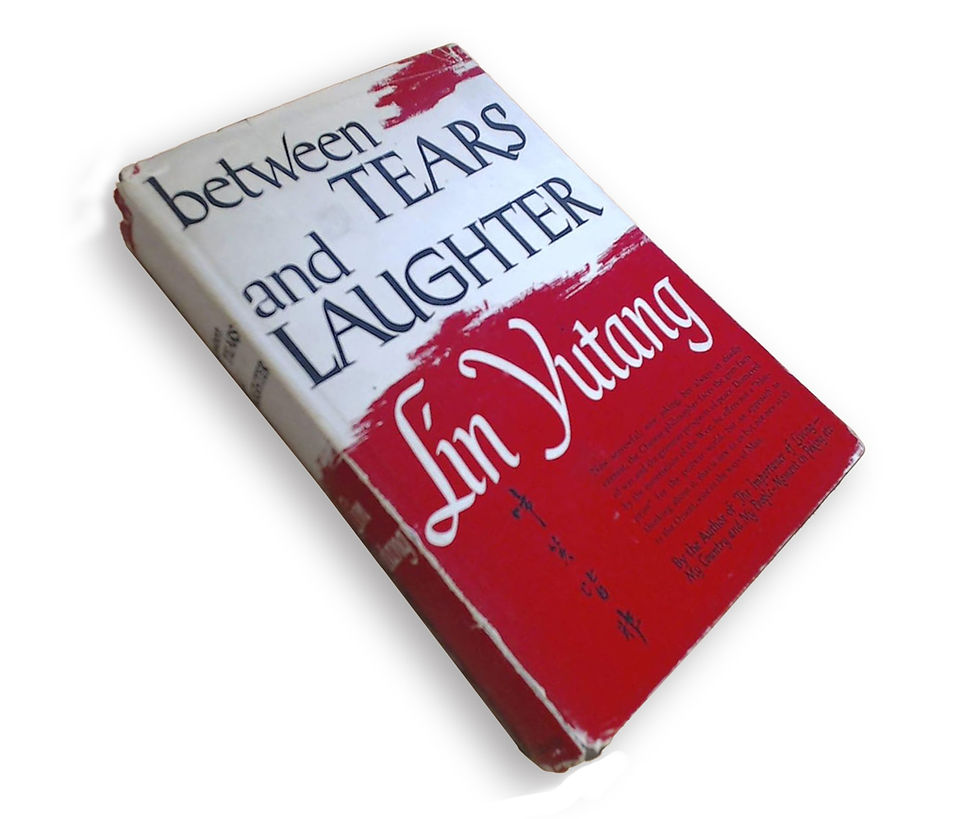
Additionally, his criticism of the West and its history of imperialism stirred up a lot of controversy. He primarily expressed this in Between Tears and Laughter (1943). However, Lin's biggest battle was with the 'China experts'.
In 1943, after Lin's last visit to war-torn China, he fervently defended the nationalist perspective and warned against the ongoing communist subversion campaign in the United States. Edgar Snow and other China experts served as the American pawns in this context.
Snow wrote in the polemical essay China to Lin Yutang that he was a 'party propagandist', who had no understanding of the actual wartime events.
He suggested that Lin had lost touch with his people due to his prolonged stay abroad. Furthermore, unlike Snow, he had never been to Yan'an and did not possess the experiences that the China experts had.
In response to the attacks, Lin had to acknowledge that his position as a Chinese within the diaspora was weak. However, he pointed out that the China experts did not read the original documents in Chinese regarding Mao Zedong's rectification campaigns and relied on information fed to them through their interpreters. Thus, the question of who represented China to America became the crux of this public debate.
Lin's friends, Pearl S. Buck and Richard Walsh, became increasingly concerned about Lin's political activities. They believed that this harmed his image as a "Chinese philosopher", an image that publisher Richard Walsh was eager to promote. In letters, he repeatedly urged Lin to cease his political activities. However, in his pursuit of the truth Lin was unwilling to do so.
In 1953, the friendship with the couple ended, seemingly over disputes regarding copyright, but as mentioned, there was more at play behind the scenes.
By the early 1950s, Lin found himself in a somewhat isolated position due to broken friendships, his life within the diaspora, his political views, and the declining popularity of his books. Ostensibly, the impoverished Lin seemed but a shadow of the writing 'acrobat' from Shanghai, who had been at the center of literary and political debate in the 1920s and 1930s.
How he dealt with these setbacks and what the consequences were for his reputation will be explored in Part II.
※※※
The inventor
Just after the end of World War II, Lin immersed himself in a new project, a prototype of an electromechanical typewriter that could produce 7,000 Chinese characters. The machine was named Mingkuai (明快), which is a combination of 'clear' and 'fast'.

It was Lin's intention to modernize China with this typewriter, as there was no adequate machine at the time to type Chinese characters quickly. The Chinese language consists of thousands of characters, which simply did not fit on a conventional typewriter.
Lin managed to solve this problem and promoted his invention as 'The Only Chinese Typewriter for Everyone'. He designed a system to combine characters from 90,000 symbols displayed on a rotating drum, somewhat similar to a hard disk.
The keyboard features 72 keys arranged in three rows and operates on the principle of 'searching'. When a key on the first, second, and finally the third row is struck, a character is combined. This character can be checked in a window before being typed onto the paper.

This method of input, which involves first searching for the correct combination, is still common in digital communication today. Lin patented his design in 1946 and had a prototype built by the Carl E. Krum Company in New York.
According to his own account, he invested $120,000 in the typewriter, which is approximately $1.8 million in today’s money, and developing the system took him thirty years of his life.
When he tried to demonstrate the prototype to Remington Typewriter Company on a rainy day in May 1947, the machine did not work; fortunately, it functioned properly the following day at a press conference.
Lin received much praise in the media for his achievement, but due to the tense political situation in China, no manufacturer was willing to take the risk of putting the typewriter into production.
The 1947 prototype remains the only existing model and can be viewed at the Lin Yutang House in Taipei.
Yu Si and the New Cultural Movement
The writers brothers Lu Xun (Zhou Shuren, 1881-1936) and Zhou Zuoren (1885-1967) founded the Yu Si group (語絲, yǔ sī: 'loose threads') in Beijing in the early 1920s. The members met twice a month on Saturday afternoons in a park to discuss literature and current political affairs.

On November 17, 1924, the first issue of the magazine was published, in which Zuoren argued that dogmatism in literature should be avoided and that the writers for the magazine should be able to freely express themselves.
When Lin Yutang began teaching English at Peking University in 1923, he became involved in the activities of this influential group. Most of the members belonged to the generation of the so-called New Culture Movement, besides the brothers, also Hu Shi (1891-1962) and Chen Duxiu (1879-1942).
The core of this movement was the creation of a new culture based on scientific and democratic principles, in response to the failure of the Republic of China. The classical Chinese tradition was seen as the greatest obstacle to a modern and progressive China and was therefore heavily criticized.
Hu Shi promoted the use of vernacular language in literature and was a strong advocate of liberal values. Chen Duxiu primarily criticized Confucianism and conservative Chinese morality. He became interested in Marxism and was one of the founders of the Chinese Communist Party in 1921.
The New Culture Movement was primarily a cultural movement, but the May Fourth Movement, an anti-imperialist student protest that erupted in 1919 after the weak response of the Chinese government to the Treaty of Versailles, transformed it into a political movement.
Lin Yutang found himself in good company when he began writing for Yu Si, but his critical pen eventually made him fear for his life. On March 18, 1926, an anti-imperialist student protest in Beijing was violently suppressed by the national army, resulting in 47 deaths and 200 injuries, including one of Lin's students.
When the media blamed the students and many of his colleagues at the university remained silent, Lin was filled with anger and vented his bitterness in Yu Si. Lin and his family were forced to leave Beijing when warlord Zhang Zongchang came to restore order in the capital.
※※※

Comments